

Unlimited battery life: Sub-threshold design
An introduction to sub-threshold design

With wearables and consumer electronics facing “all-day battery“ demands, power consumption sometimes outweighs the need for speed. Some devices take this concept further, relying on sub-threshold circuit design to allow devices to stay on for up to years on heavily reduced power.
What is sub-threshold design?
Sub-threshold design is an approach where a digital circuit's supply voltage is set to below the threshold voltage of the transistors. Specifically, the gate voltage of a MOSFET is less than the threshold voltage (VGS < VTH).
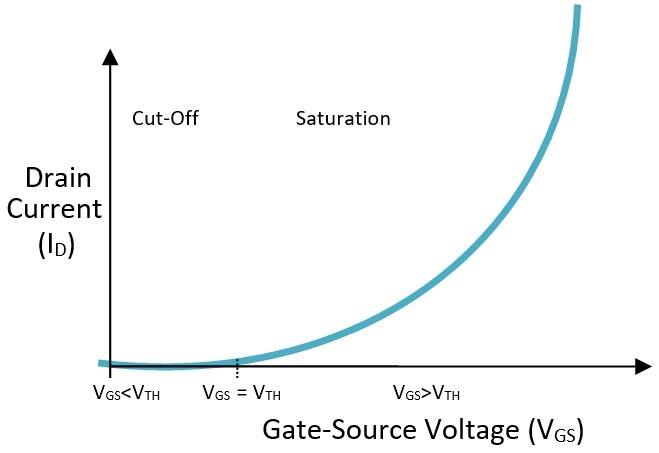
Image from Hacktronic
Thus, the MOSFET operates in the cut-off region, which normally means the device doesn’t conduct current. However, MOSFETs do leak voltage in this region, which gives rise to a small current. This allows carriers to diffuse across the junction rather than drift.
The trade-off
Even though the device is ‘off’, this weak current can still switch logic states. As a MOSFET's drain-source current is controlled by the voltage at the gate, finding an optimum supply voltage that balances leakage and dissipated switching energy allows for the engineering of extremely efficient devices.
| The pros | The cons |
|---|---|
| Energy efficiency: Significantly less energy per operation. | Speed: They operate much more slowly. |
| Leakage: Reduced leakage power. |
Where is this useful?
In most cases, operating at a sub-threshold voltage is useless as performance is much too slow. Standard devices are measured in MHz or GHz (switching millions or billions of times per second). Sub-threshold design is beneficial for systems which are critically energy constrained. In these scenarios, conserving energy is the primary constraint and speed is largely irrelevant. The goal is to minimize energy per operation to achieve multi-year lifetimes.
Common examples include:
- Micro-sensor nodes: Used for health, structural, or habitat monitoring, these require extremely low power because data acquisition is slow (seconds to minutes instead of milli or microseconds), and battery replacement is impossible or impractical.
- Passive RFID tags: These tags are powered by energy converted from the received radio signal; lower digital power requirements allow for a greater operational distance from the reader.
The ultimate goal: unlimited lifetime
The ultimate motivator for sub-threshold design is achieving system lifetimes that go beyond multi-year battery life. To do this, systems using sub-threshold design must have:
- Energy harvesting: Micro-sensor nodes need theoretically unbounded lifetimes. This is possible through energy harvesting, which converts ambient energy (like solar, thermal, or vibration) into electrical power.
- Microwatt power consumption: To enable reliable energy harvesting, micro-sensor nodes must keep their average power consumption in the 10–100 µW range.
As the world becomes more digital, and edge computing becomes more prevalent in society, sub-threshold design might see more adoption in applications in the future to ensure ultra-long lifetimes.